


Interview with Budi Arie (source: antaranews.com)
Projo’s Chairman, Budi Arie Setiadi, drew public attention with his statement at the organization’s annual congress on Sunday, October 2, 2025. He asserted that the name “Projo” is not an abbreviation of “Pro-Jokowi”, but rather originates from Sanskrit and Old Javanese (Kawi), meaning “state” or “people.” The remark coincided with Projo’s decision to change its logo, which had previously featured the silhouette of Indonesia’s 7th President, Joko Widodo (Jokowi).
Claim Context
Projo has long been known to the public as short for “Pro-Jokowi.” The organization was indeed founded to unite volunteer groups supporting Jokowi in the 2014 and 2019 presidential elections.
Recently, however, the group announced a transformation of its identity, including plans to redesign its logo and reaffirm that “Projo” is not an acronym related to Jokowi’s name.
“Projo means state and people. In Sanskrit, it means ‘state,’ and in Old Javanese Kawi, it means ‘people,’” explained Budi Arie to reporters after the Projo Congress in Jakarta.
“There’s no abbreviation. It’s just that media friends call it ‘Pro-Jokowi’ because it’s easy to pronounce,” he added.

Projo Logo (source: wikipedia)
Fact Check
A. Indonesian–Sanskrit Dictionary
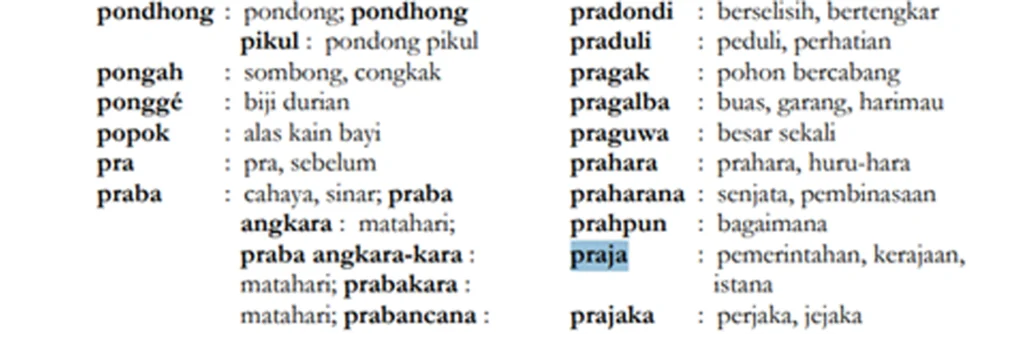
Translation of the word “Praja” (screenshot from the Indonesian–Sanskrit dictionary
According to Kamus Bahasa Indonesia–Sansakerta by Dr. Purwadi, M.Hum. and Eko Priyo Purnomo, S.IP. (2008), the word “projo” does not literally appear in Sanskrit. The closest phonetic and semantic match is “praja,” which means government, kingdom, or palace.
In classical Indian political context, praja can also mean citizens or subjects of a kingdom. However, there is no record in the dictionary of “projo” as a derived or alternative pronunciation of “praja.”
B. Kamus Bahasa Indonesia – Jawa Kuno
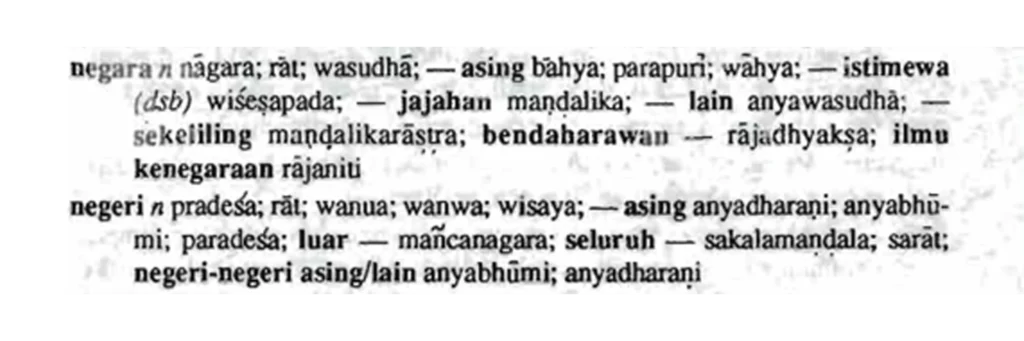
Translation of “country” and “state” (screenshot from the Indonesian–Old Javanese dictionary)
A search in the Indonesian–Old Javanese Repository by the Ministry of Education (Kemendikdasmen) also found no explicit entry for “projo.”
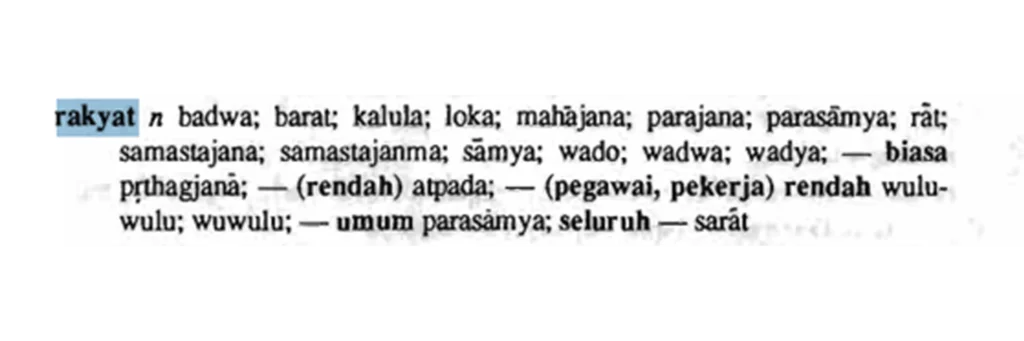
Translation of “people” (screenshot from the same dictionary)
In Kawi, the terms for “negara” or “negeri” do not use “projo.” The closest equivalent for “rakyat” is “prajana.” Thus, etymologically, “projo” has not been identified as a standard vocabulary item in either Sanskrit or Old Javanese.
C. Possible Phonetic Variant of “Praja” Requires Further Study
It remains unclear whether the term “projo” is simply a localized pronunciation of “praja.”
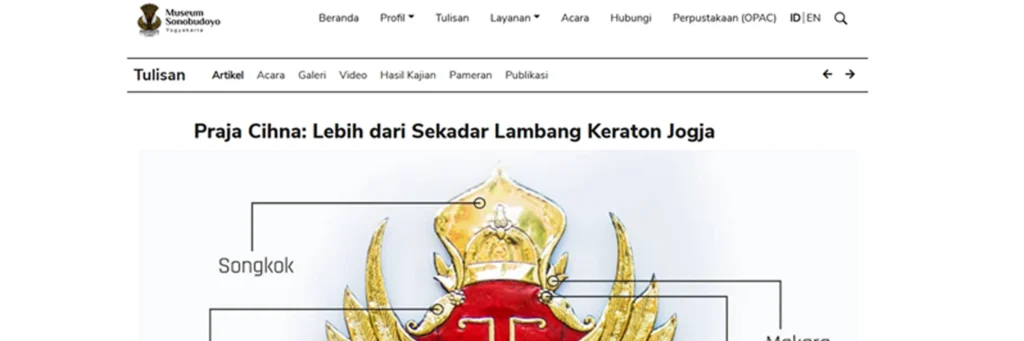
Explanation of “Praja Cihna” as the Royal Emblem of Yogyakarta Palace (screenshoot from https://sonobudoyo.jogjaprov.go.id/)
Various classical sources indicate that the word “praja” was consistently written and pronounced as “praja,” not “projo.”
For instance, the Sonobudoyo Museum of Yogyakarta, in its publication about the Royal Emblem (Praja Cihna) of the Yogyakarta Palace, explains that “praja” derives from Sanskrit, meaning “servant of the state,” while “cihna” means “true character.”
The term “praja” is also used in “Praja Muda Karana” (Pramuka), meaning “young people who love to work and create.”
Although there is a village named “Toto Projo” in East Lampung Regency, the official website of the village does not provide any etymological explanation on whether “Projo” comes from “Praja” or holds a distinct meaning.
D. Academic Perspectives
According to a Kompas.com report (Tuesday, November 4, 2025), Imam Sutarjo, a lecturer in the Regional Literature Department, Faculty of Cultural Sciences, Sebelas Maret University (UNS), explained that “projo” indeed originates from Sanskrit and Old Javanese, meaning “state” and “people.”
However, there is still no authoritative linguistic literature explicitly recording the existence of the word “projo” in either language.
Therefore, further academic research is required to determine whether “projo” is a popular phonetic adaptation of “praja” or a modern Javanese cultural reinterpretation.
Conclusion
Budi Arie’s claim that “Projo” means “state” or “people” in Sanskrit and Kawi is not fully supported by strong linguistic evidence.
Thus, on a Fact Meter, the claim could be categorized as “Half Light” or true but incomplete.
While the intended meaning aligns with that of praja (“people” or “state”), linguistically, the term “projo” is absent from the main lexical sources of both Sanskrit and Old Javanese.
Further clarification from linguists and official language institutions is still needed to confirm whether “Projo” is a popular phonetic variant or a modern symbolic interpretation.(*)