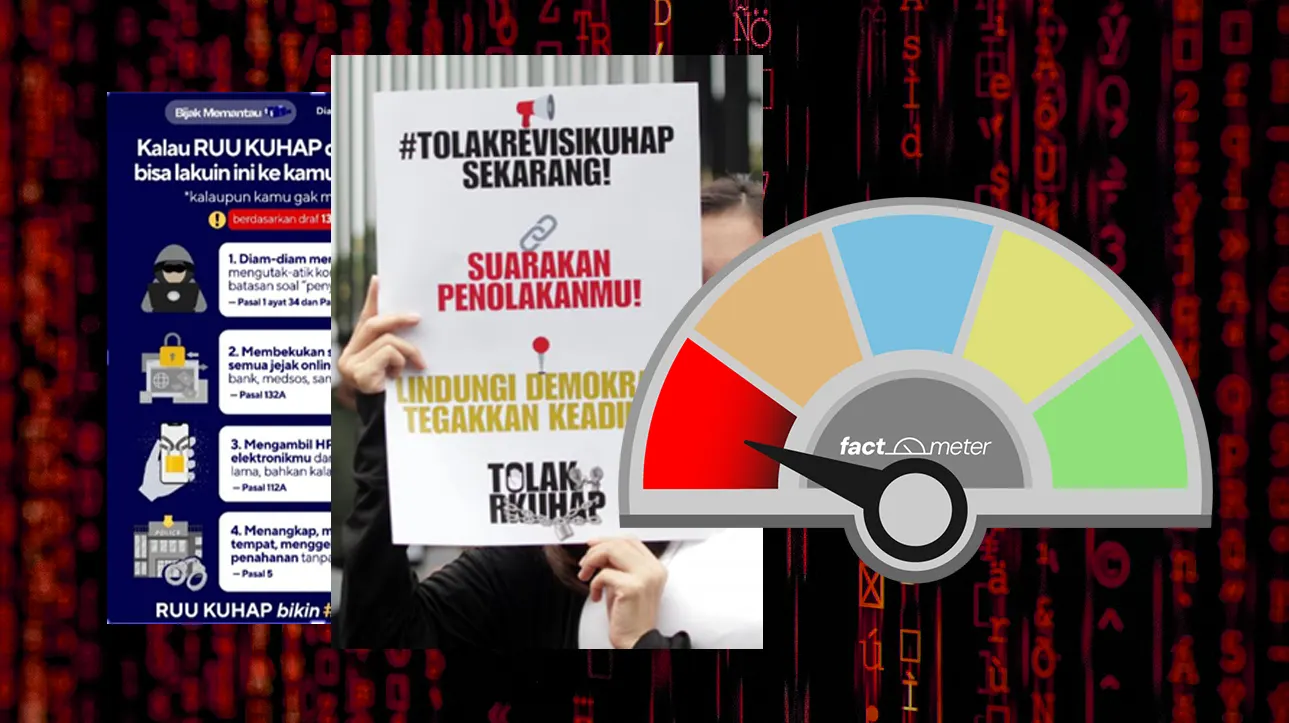

Following the passing of the new KUHAP Bill on Tuesday (18/11/2025), the digital space has been flooded with various claims suggesting that the police can now act arbitrarily: from wiretapping without authorization, blocking bank accounts unilaterally, seizing digital data without court orders, to arresting individuals without sufficient evidence.

Opposition to the KUHAP Revision (source: icjr.or.id)
Numerous posts, infographics, and snippets of information circulating on social media have raised public concern about potential abuses of authority by investigators.
Claim Context

Issue of the KUHAP Bill (source: icjr.or.id)
After the new KUHAP was passed, various posters and snippets spread on social media claiming that the law grants broad powers to the police in the following contexts:
-
Police can wiretap, record, and monitor digital communication without a court order. According to circulating claims, this issue stems from Article 1 paragraph 34 and Article 124.
-
Police can block bank accounts, digital data, online traces, or seize assets without judicial approval. This claim reportedly refers to Article 123A.
-
Claims circulating mention that Article 5 may allow police to arrest or detain individuals without confirming a criminal offense.
These narratives have sparked widespread concern about potential abuses of police power and violations of citizens’ rights.
Fact-Checking
A. Wiretapping, Recording, and Monitoring Digital Communication Without Authorization
According to the Chair of Commission III of the Indonesian House of Representatives (DPR RI), Habiburokhman, the new KUHAP does not directly regulate wiretapping. The claim that police can conduct “silent tapping” or access communication data without authorization is incorrect.
The circulating rumor claims that Article 1 paragraph 34 and Article 124 of the new KUHAP provide a basis for unrestricted wiretapping. However, in the draft KUHAP passed by the DPR, wiretapping provisions are actually contained in Article 1 paragraph 36 and Article 136.
Article 1 paragraph 36 defines wiretapping as an activity to obtain private information secretly through various technical methods, including listening, recording, diverting, or capturing electronic information transmissions via cable, wireless networks, or other digital communication systems.
Meanwhile, Article 136 stipulates that investigators may conduct wiretapping for investigation purposes. However, the technical details, procedures, and limitations of wiretapping are not regulated within KUHAP itself but will be governed by a separate law specifically concerning wiretapping.
B. Blocking Bank Accounts, Digital Data, Online Traces, or Seizing Assets Without Judicial Approval
Claims circulating state that Article 132A in the older draft allows police to freeze savings, bank accounts, social media, and all digital traces unilaterally. However, in the KUHAP law that has been passed, the rules on blocking are actually detailed in Article 140, not the articles cited in viral posts.
Article 140 of the KUHAP establishes several key points:
Blocking can only be carried out by investigators, prosecutors, or judges, but must:
-
Obtain authorization from the head of the district court (paragraphs 1–2).
-
Include reasons, the relevance of the object to be blocked, and the purpose of the blocking in the request (paragraph 3).
-
Be reviewed thoroughly by a judge within a maximum of two days (paragraph 4).
The KUHAP does allow for blocking without prior authorization in emergency situations (paragraphs 7–8), such as potential asset transfers or cybercrime. However, these emergency actions must:
-
Be submitted for judicial approval within 2×24 hours (paragraph 9),
-
Be decided by the judge within the next 2×24 hours (paragraph 10), and
-
Be revoked within three working days if the approval request is rejected (paragraph 12).
Thus, the new KUHAP does not grant unilateral blocking powers without judicial oversight; instead, it establishes strict mechanisms requiring court authorization and clear deadlines.
C. Arrest and Detention Without Confirmation of a Criminal Offense
Claims circulating argue that Article 5 of the new KUHAP allows police to arrest or detain someone without confirming a criminal act. However, Article 5 actually regulates the authority of investigators, not a justification for arbitrary arrests.
In the new KUHAP:
-
Article 5 outlines basic duties of investigators, such as receiving reports, searching for and collecting evidence, verifying identities, or conducting other responsible actions (paragraph 1).
-
It states that investigators may carry out arrests or detentions, but only under the order of the investigating officer (paragraph 2), not on their own initiative.
-
This authority must still follow general procedures for arrest or detention, including the requirement of at least two pieces of evidence, hierarchical approval, and reporting to the investigating officer (paragraph 3).
Thus, Article 5 does not provide a basis for arrests without suspicion of a criminal offense but merely clarifies that investigators may assist investigators in carrying out legal actions according to existing procedures.
Conclusion
The claim that the new KUHAP grants the police the authority to wiretap without authorization, block accounts unilaterally, seize digital data without court proceedings, or arrest or detain someone without confirming a criminal offense is not supported by the provisions of the newly passed KUHAP. Fact-checking indicates that each of these actions remains regulated through legal procedures that involve judicial authorization, timelines, evidentiary requirements, and judicial oversight.
Accordingly, based on a fact-meter, these claims fall into the category of “Pure Fantasy,” meaning complete hoaxes with no basis in the new KUHAP.
The circulating narratives twist or misinterpret unrelated articles and ignore clearly stated legal requirements. Therefore, the public should be cautious of posters, posts, or chain messages spreading misinformation about the new KUHAP.